A flapping-wing drone does not fly on rigid wings. As each wing sweeps through a stroke it bends and twists under its own aerodynamic and inertial loads — and that passive deformation is a large part of how the wing makes lift. We worked with the Aerial Robotics Lab at Imperial College London to measure it directly.
Why the wing won't hold still
The wing of a flapping drone is thin, light and fast. It reshapes itself continuously through every beat, and the drone carrying it rarely holds position — it drifts and yaws around the flight volume as it works to stay aloft. To recover the wing's true shape you need footage that is both fast enough to freeze the stroke and locked onto a wing that will not stay put.
A fixed camera cannot do both at once. Frame it wide enough to be sure of catching the drone and the wing is a handful of pixels; frame it tight and the drone leaves the shot. A camera operator cannot pan fast or precisely enough to keep a wing this small centred either.
Capturing it with DART-Mo
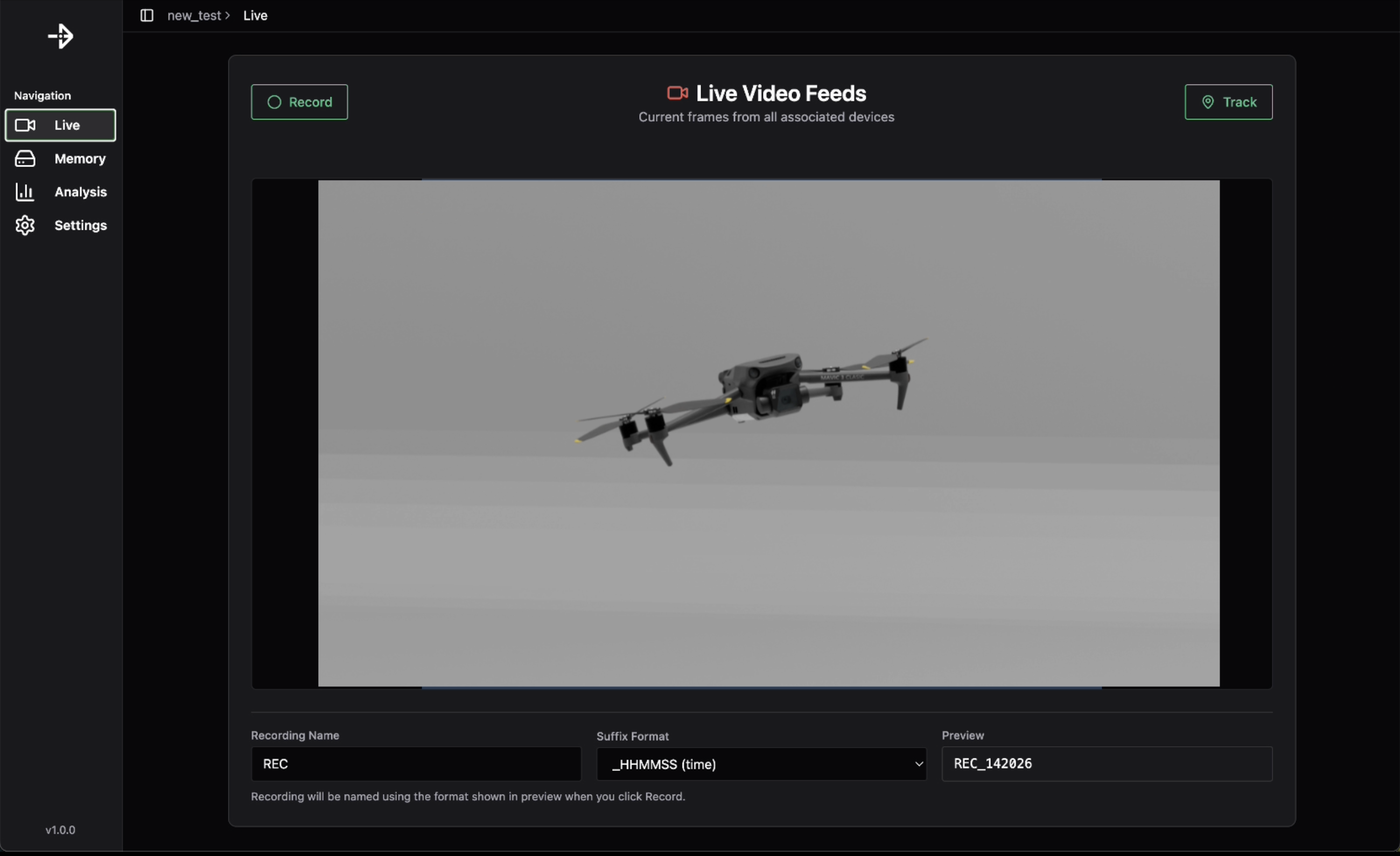
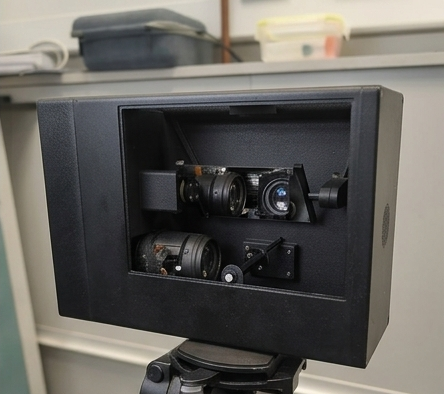
DART-Mo solved the framing problem. Following the drone through the motion-capture volume, it kept the wing centred and sharp for the whole of a recording made at over 200 frames per second. Every beat of the stroke landed in frame, in focus, and large enough to measure from.
To make the surface readable, one wing carried a printed dot-grid — a regular pattern of markers whose movement through the footage encodes how the wing deforms. That is the orange grid tracked across the wing in the clip above.
From footage to a 3-D surface
The analysis runs on a purpose-built pipeline, the Wing Deformation Digitizer. It locates the dot-grid in the footage, tracks every marker frame by frame, and fits a smooth bending surface to the grid using a camera-projection least-squares optimisation. Reprojecting that fitted grid back onto the original frames confirms it lines up with the real wing.
The result is a reconstruction of the wing's surface across the entire stroke — the tracked grid resolved into 3-D geometry that bends and twists in step with the footage.
- Digitised grid — every marker on the wing located in each frame of the recording.
- A fitted bending surface, recovered by camera-projection least-squares optimisation.
- A reprojection overlay that checks the fit against the original footage.
- A 3-D reconstruction of the wing's shape across the full stroke cycle.
What it's for
Knowing how a wing actually deforms — rather than how it was designed to — feeds straight back into wing design and the flight-control models for flapping-wing drones. It is also a clean demonstration of what DART-Mo is built for: not the footage itself, but footage good enough to measure from.
Wing Deformation DigitizerThe analysis pipeline used in this project, on GitHub.